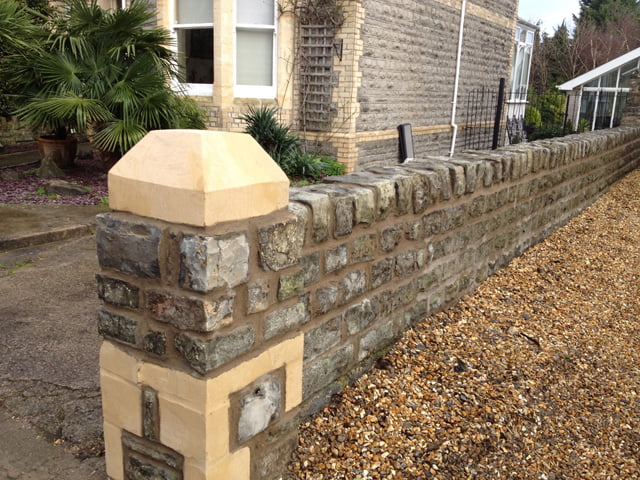
Lime Mortar Repointing Cardiff
If you own an older property in Cardiff, Penarth or the Vale of Glamorgan, the mortar holding your stonework or brickwork together is just as important as the stone itself. Many pre-1919 buildings were constructed using traditional lime mortar, a material that works in harmony with the natural movement and breathability of older walls. Over the decades, well-meaning but misguided repairs using modern cement-based mortars have caused significant damage to countless period properties across South Wales.
At Vale Stone Masonry, we specialise in lime mortar repointing throughout Cardiff, Penarth, Barry, Cowbridge and the surrounding areas. Our skilled masons understand the critical differences between lime and cement mortars and why using the correct material is essential for the long-term health of your building.
Why Lime Mortar Instead of Cement?
Modern Portland cement mortar is significantly harder and less flexible than traditional lime mortar. When cement is used to repoint an older building, it creates a rigid, impermeable barrier that traps moisture inside the wall rather than allowing it to evaporate naturally. Over time, this trapped moisture causes the softer stone or brick to deteriorate, often crumbling and spalling around the hard cement joints. The result is accelerated decay of the very fabric you were trying to protect.
Lime mortar, by contrast, is softer than the surrounding masonry. It allows moisture to pass through the joints and evaporate harmlessly, keeping the wall dry and healthy. Lime mortar is also slightly flexible, accommodating the natural thermal movement of a building without cracking. When lime mortar does eventually wear, it sacrifices itself rather than the stone, meaning future repointing is straightforward and the original masonry remains intact.
The Repointing Process
Proper lime mortar repointing is a skilled craft that requires patience and experience. The process begins with carefully raking out the old, defective mortar to a sufficient depth, typically at least twice the width of the joint. This must be done by hand using appropriate tools to avoid damaging the arrises of the stone or brick. We never use angle grinders for mortar removal on period buildings, as this causes irreversible damage to the masonry edges.
Once the joints are prepared and thoroughly dampened, we apply the new lime mortar in layers, allowing each layer to cure properly before the next is added. The final finish is tailored to match the original joint profile of your building, whether that is a flush finish, a slightly recessed joint or a traditional weatherstruck profile. We take great care to match the colour and texture of the original mortar, often using locally sourced aggregates to achieve an authentic appearance.
Types of Lime Mortar We Use
We work with both non-hydraulic lime putty mortars and natural hydraulic lime (NHL) mortars depending on the requirements of each project. Non-hydraulic lime putty offers the greatest breathability and flexibility, making it ideal for sheltered walls and interior work. Natural hydraulic lime mortars provide a faster initial set and greater durability, suitable for more exposed elevations and areas subject to weathering. We select the appropriate lime type and mix design for each specific application, ensuring the mortar performs correctly in its intended location.
Which Buildings Need Lime Mortar?
As a general rule, any building constructed before 1919 is likely to have been built with lime mortar and should be repointed using lime. This includes the many Victorian and Edwardian terraces found throughout Cardiff and Penarth, Georgian townhouses, stone-built farmhouses, chapels, churches and boundary walls. Listed buildings and those in conservation areas will almost certainly require lime mortar repointing, and inappropriate cement repairs can lead to enforcement action from the local authority.
Even if your property is not listed, using the correct lime mortar will protect your investment, maintain the character of your home and avoid the costly damage that cement repointing inevitably causes to older buildings.
Signs Your Property Needs Repointing
Common indicators that your building needs repointing include mortar joints that are crumbling, receding or missing entirely, damp patches on internal walls, blown or spalling stonework adjacent to hard cement repairs, and visible cracks running through existing mortar joints. If you notice any of these signs, it is worth having a professional assessment before the damage progresses further.
Our Service Area
We carry out lime mortar repointing across Cardiff, Penarth, Barry, Dinas Powys, Cowbridge, Llantwit Major, Bridgend and throughout the Vale of Glamorgan and South Wales. Whether you have a single wall that needs attention or an entire property requiring repointing, we provide honest advice and detailed quotations with no obligation.
Call us today on 07500 871 637 or use the contact form on this page to arrange a free site visit and quotation.
Our Service Areas
We provide this service across Cardiff and the surrounding area, including Cardiff, Penarth, Barry and throughout the Vale of Glamorgan.
Why Choose Vale Stone Masonry?
- Experienced lime mortar specialists
- Traditional hand tools only – no angle grinders
- NHL and lime putty mortars available
- Colour and texture matched to original mortar
- Suitable for listed buildings and conservation areas
- Free site visits and quotations
- Fully insured
- Serving Cardiff, Penarth and the Vale of Glamorgan